
Runtime integration
Intermediate Last updated Jul 9, 2026
On this page
Questwright is engine-native and standalone; the integration surface is deliberately small. This page covers every touch point between the plugin and your game code (C++ or Blueprint).
The quest component
Quest progress is a fact about (player, quest). It lives on UQuestwrightQuestComponent,
auto-added to each PlayerState (never stored on NPCs). Resolve it from anywhere:
UQuestwrightQuestComponent* Comp = UQuestwrightQuestComponent::Get(SomeActor);
UQuestwrightQuestComponent* Local = UQuestwrightQuestComponent::GetLocalPlayer(World);
Crediting objectives
When something quest-relevant happens, such as a kill or a pickup, make one call
(BlueprintCallable, server-authoritative, idempotent per EventSourceId):
Comp->ReportObjectiveEvent(Instigator, Type, MatchTags, LocationTags, EventSourceId);Every active objective whose type and (hierarchically matched) target/location tags fit
the event increments. Pass the killer as Instigator and only that player is credited; pass
none and all players are (shared-world fallback). For story beats, a trigger or dialogue can
instead call:
Comp->CompleteObjective(QuestId, ObjectiveId);UI out of the box
Add UQuestwrightQuestHUDComponent to your PlayerController and you get the on-screen
objective tracker, the quest journal (bind a key to ToggleJournal) and quest-state toasts.
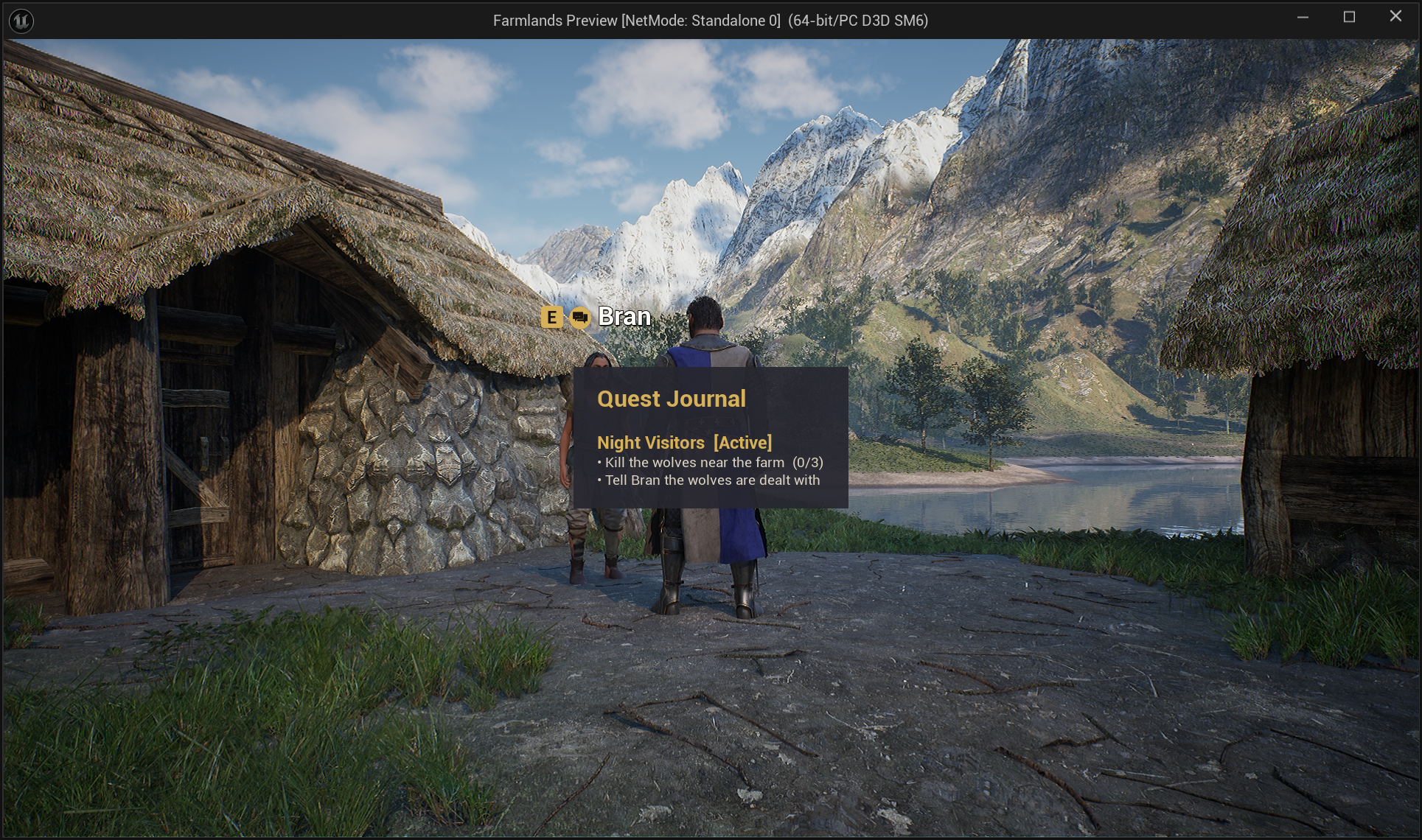
All widgets are C++-built and replaceable with your own subclasses, or you can skip them entirely and drive a custom UI from the delegates below.
Provider seams
Instead of shipping its own inventory or stats, Questwright talks to yours through interfaces with working defaults:
| Seam | Interface | Implementable in |
|---|---|---|
| Inventory (item conditions, item rewards) | IQuestwrightInventoryProvider | Blueprint or C++ |
| Stats / attributes (attribute conditions) | IQuestwrightStatProvider | Blueprint or C++ |
| Saving backend | IQuestwrightSaveProvider | C++ |
| Voice synthesis | IQuestwrightVoiceProvider | C++ (editor) |
| Facial receiver, smart objects | provider interfaces | C++ |
Quest state as GameplayTags
Call SetTagTargetActor(Pawn) and the component projects Questwright.Quest.State.* tags onto
an AbilitySystemComponent, so quest state becomes usable in ability activation requirements and
any tag-based condition system you already have.
Delegates
For custom UI or game reactions:
OnQuestStateChanged: accepted / completed / declined / failed;OnObjectivesChanged: a counter moved or an objective completed;OnJournalDirty: anything the journal displays changed;OnProgressLoaded: stored progress was applied (see Saving & multiplayer).
Dynamic text tokens
{PlayerName} and custom {Token} placeholders in dialogue and journal text are substituted
at display time by a GameInstance subsystem:
UQuestwrightTextVarsSubsystem* Vars = GameInstance->GetSubsystem<UQuestwrightTextVarsSubsystem>();
Vars->SetPlayerName(TEXT("Ellie"));
Vars->SetTextVar(TEXT("Faction"), TEXT("Rangers"));   // used as {Faction}
Both setters are BlueprintCallable. Substitution uses FText::Format, so it is
localization-safe.
Dialogue → quest bridge
Dialogue scenes mutate quest state through their on_end effects (quest: accept / turnin / decline / fail, set: flags, grant_tag, grant_quest), so you don’t write glue code between
conversations and quests. See
Objectives & progression.